Community Signs Flashcards: A Practical Review for Educators
In the landscape of early childhood education and special needs support, the ability to interpret visual cues is not merely an academic exercise; it is a critical life skill. For educators, therapists, and parents working with young learners, bridging the gap between abstract symbols and real-world application remains a persistent challenge. Community Signs Flashcards emerge as a targeted resource designed to address this specific need. Rather than serving as a generic teaching aid, this set focuses on the essential infrastructure of public safety and navigation that children encounter daily. By examining the design, utility, and pedagogical approach of these materials, we can determine their true value in a professional or home-based learning environment.
The Core Purpose of Visual Literacy Tools
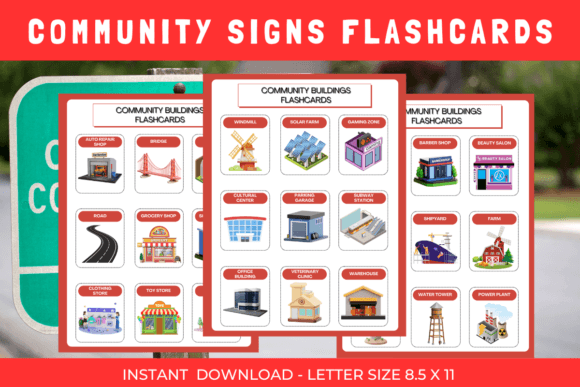
The primary function of Community Signs Flashcards is to accelerate sign recognition and comprehension among early learners. The curriculum surrounding traffic and community safety often relies heavily on rote memorization, which can be ineffective for students who struggle with traditional text-heavy instruction. This flashcard set shifts the focus to visual literacy. It presents 63 distinct cards featuring high-contrast images of common signs such as stop signals, pedestrian crossings, traffic lights, and construction warnings.
For professionals working with Pre-K through 2nd-grade students, the objective is to move beyond simple identification. The goal is to foster an understanding of what these signs dictate in behavior. When a student sees a red octagon, they should not only know it is a "Stop" sign but also understand the immediate action required. These flashcards are structured to facilitate that cognitive leap by pairing clear imagery with simple text labels. This dual-coding approach reinforces reading skills while simultaneously building functional awareness of the physical world.
Evaluating Design and Usability
From a practical standpoint, the effectiveness of any educational tool hinges on its presentation. In the case of Community Signs Flashcards, the design prioritizes clarity and boldness. The images are rendered with sufficient contrast to ensure visibility even at a distance or for students with visual processing differences. This is a crucial consideration for special education settings where sensory overload or visual impairment may be factors.
The inclusion of simple text labels serves a dual purpose. First, it supports emerging readers by associating the symbol with its written name. Second, it provides a scaffold for vocabulary development in ESL (English as a Second Language) contexts. However, the utility of these cards depends heavily on the quality of the print output. Since these are digital downloads intended for printing, the end-user must ensure access to high-quality color printers. Faded ink or low-resolution prints could undermine the visual impact, rendering the bold lines less distinct. Therefore, while the digital asset is robust, the final product's reliability rests on the user's hardware capabilities.
Versatility Across Educational Settings
One of the most significant strengths of this resource is its adaptability. Unlike rigid textbooks, Community Signs Flashcards can be integrated into various workflows:
- Classroom Instruction: Teachers can use them for morning circle time, sorting activities, or as part of a larger unit on community helpers and safety.
- Homeschool Environments: Parents can incorporate these into daily drives or neighborhood walks, turning real-world observation into an interactive game.
- Therapy Sessions: Occupational and speech therapists can utilize the cards to work on matching, sequencing, and verbal labeling skills within a structured setting.
This flexibility allows the same set of 63 cards to serve different curricular goals without requiring additional purchases. A teacher might use them for a science lesson on physics and motion, while a special education specialist uses them for behavioral regulation training regarding road safety.
Real-World Application and Effectiveness
Theoretical knowledge often fails to translate into practical behavior without context. Community Signs Flashcards attempt to bridge this gap by focusing on signs that have immediate relevance to a child's daily routine. The selection includes staples like traffic lights and crosswalks, which are encountered frequently. However, the true test of these materials lies in how they are deployed.
When used statically—simply holding up a card and asking for the name—the benefit is limited to memory recall. To maximize effectiveness, educators should employ dynamic strategies. For instance, creating a mock street scene in the classroom where students must navigate based on the signs drawn from the deck adds a layer of experiential learning. This transforms the activity from passive recognition to active decision-making.
Furthermore, for ESL students, these cards provide a necessary visual anchor. Language barriers often make abstract concepts difficult to grasp, but a picture of a "No Parking" sign is universally understandable. The consistency of the imagery helps build a shared vocabulary between the instructor and the student, reducing frustration and increasing engagement.
Strengths and Limitations
Like any educational resource, Community Signs Flashcards possess both distinct advantages and potential constraints. Understanding these helps professionals decide if the tool fits their specific workflow.
Key Strengths
- Comprehensive Coverage: With 63 cards, the set covers a wide range of scenarios, ensuring that students are exposed to more than just the basics.
- Visual Clarity: The bold, colorful design minimizes distraction and highlights the essential features of each sign.
- Cross-Disciplinary Utility: The resource supports literacy, social-emotional learning, and safety education simultaneously.
- Cost-Efficiency: As a downloadable format, it eliminates shipping costs and allows for instant updates or reprints if cards are damaged.
Potential Limitations
- Lack of Contextual Scenarios: While the cards show the signs, they do not inherently provide the complex scenarios in which these signs appear (e.g., a four-way intersection vs. a single-lane stop). Educators must supplement the cards with role-play or field trips.
- Durability Concerns: Standard paper prints may wear out quickly in high-traffic classrooms. Laminating is highly recommended, adding an extra step to the preparation process.
- Regional Variations: Traffic signs can vary slightly by country or region. Users should verify that the signs depicted align with local regulations to avoid confusion.
Who Benefits Most?
The target audience for Community Signs Flashcards is broad, yet specific. They are particularly valuable for:
- Special Education Professionals: Students with autism spectrum disorder or developmental delays often thrive on visual aids. The predictability and clarity of these cards can reduce anxiety related to navigating new environments.
- ESL Instructors: Teachers working with non-native speakers need tools that bypass linguistic complexity. These cards offer a direct path to functional language acquisition.
- Early Childhood Educators: For Pre-K and Kindergarten teachers, introducing safety concepts early is vital. These cards provide a structured way to integrate safety into the daily curriculum.
- Homeschooling Parents: Families seeking to combine outdoor exploration with indoor learning will find these cards useful for planning field trips and reinforcing observations made during walks.
Long-Term Value and Integration
Investing time in preparing and utilizing Community Signs Flashcards yields long-term dividends in student confidence and independence. The skills developed through recognizing community signs are transferable. A student who learns to identify a "Yield" sign today is better prepared to navigate a busy parking lot tomorrow. This builds a foundation for real-world literacy that extends far beyond the classroom walls.
To ensure longevity, users should consider digitizing their usage alongside physical copies. Taking photos of the cards or using them in digital presentations can extend their lifespan. Additionally, integrating them into a broader safety curriculum ensures that the learning is reinforced over time rather than treated as a one-off activity.
Final Assessment
Community Signs Flashcards represent a solid, practical addition to the toolkit of any educator focused on early development and safety. They succeed not by offering flashy gimmicks, but by providing clear, consistent, and relevant visual data that supports cognitive growth. While they require active facilitation to reach their full potential, the underlying content is robust and well-suited for diverse learning needs. For professionals looking to enhance their students' understanding of the world around them, this resource offers a reliable, cost-effective solution that balances educational rigor with engaging design.