Mastering 2 Digit Addition and Subtraction
Mathematics education often hinges on the transition from single-digit arithmetic to the more complex world of two-digit operations. This shift is not merely a step up in difficulty; it is a fundamental cognitive leap where students begin to grasp the concept of place value in action. 2 Digit Addition and Subtraction serves as the cornerstone for numerical fluency in early elementary education, particularly for students in grades 2 and 3. For educators, parents, and content creators, understanding the nuances of these operations provides a rich landscape for developing engaging learning materials that go beyond rote memorization.
The beauty of this mathematical domain lies in its duality: it can be approached through straightforward practice without regrouping or challenged with the complexities of borrowing and carrying over. This distinction allows for a scaffolded learning experience where confidence is built before complexity is introduced. When designing resources or planning lessons, recognizing the difference between these two modes is essential for creating effective educational tools.
The Foundation: Understanding Without Regrouping
Before diving into the mechanics of borrowing and carrying, students must first master the alignment of digits and the logic of place value. Worksheets focusing on 2 Digit Addition And Subtraction Without Regrouping provide a safe environment for this exploration. In these problems, the sum of the ones column never exceeds nine, and the minuend in subtraction is always larger than the subtrahend in the ones place.
This approach is vital for building initial confidence. It allows learners to focus entirely on the structure of the equation rather than getting bogged down by procedural rules. For teachers and homeschool parents, this stage is an opportunity to introduce visual aids, such as base-ten blocks or number lines, to reinforce the concept that tens stay with tens and ones stay with ones. Creative adaptations might include turning these static problems into interactive games where students physically move objects to solve equations, bridging the gap between abstract numbers and concrete reality.
Leveling Up: The Art of Regrouping
Once the foundation is solid, the introduction of 2 Digit Addition And Subtraction With Regrouping transforms the learning process. This is where the true magic of our base-ten system becomes apparent. Regrouping, often called "carrying" in addition and "borrowing" in subtraction, requires students to understand that ten ones can be exchanged for one ten, and vice versa.
This concept is frequently a stumbling block, but it also offers a unique opportunity for creative problem-solving. Instead of presenting dry rows of numbers, educators can frame regrouping as a story of exchange. Imagine a scenario where a student has 17 apples and needs to give away 9. They cannot take 9 from 7, so they must "break open" a box of ten apples to make the transaction possible. This narrative approach helps demystify the algorithmic steps involved in borrowing.
For those creating teaching materials, incorporating visual cues that highlight the movement of values—such as color-coding the carried digit or drawing arrows for borrowed amounts—can significantly enhance clarity. These small design choices turn a potentially confusing procedure into a logical, visual journey.
Designing Effective Practice Materials
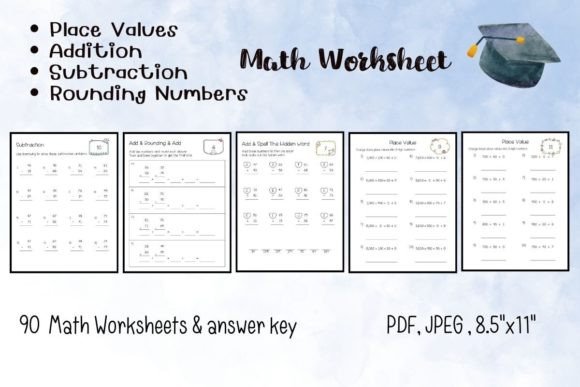
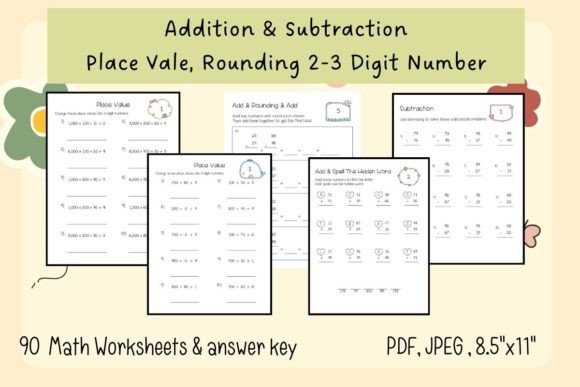
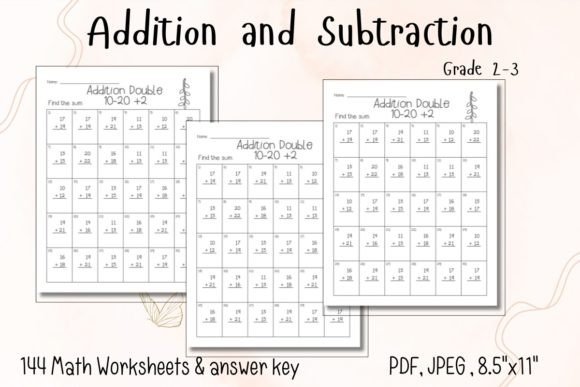
The versatility of 2 Digit Addition and Subtraction makes it an ideal subject for a wide range of formats. A comprehensive resource pack, such as a collection containing 60 worksheets across 144 pages, offers the depth needed for sustained practice. However, quantity alone does not ensure quality. The structure of the material matters immensely.
A well-organized workbook should progress logically. Starting with Part 1: Addition And Subtraction Practice allows for mixed review, ensuring students can distinguish between the two operations. Following this, dedicated sections like Part 2: Two-Digit Addition and Part 3: Two Digit Subtraction allow for focused drilling on specific skills. This segmentation helps identify exactly where a student is struggling—is it the concept of addition, or specifically the mechanics of regrouping within addition?
When formatting these materials, the standard 8.5″ x 11″ inch layout remains the industry standard for printability and ease of use. Whether distributing files as high-quality JPGs for digital tablets or PDFs for physical printing, ensuring that the font size is legible and the spacing is generous prevents visual fatigue. Cluttered pages can overwhelm young learners, while clean, organized layouts encourage focus and accuracy.
Integrating Answer Keys for Self-Assessment
Incorporating answer keys is not just a convenience; it is a pedagogical necessity. For home school parents and independent learners, immediate feedback is crucial. An answer key allows students to self-correct, fostering a sense of autonomy and responsibility for their own learning. For teachers, these keys streamline the grading process, allowing them to spend more time analyzing patterns in errors rather than checking individual calculations.
Furthermore, answer keys can serve as a tool for peer review. Students can swap papers and check each other's work, promoting collaboration and communication skills alongside mathematical proficiency. This social aspect of learning can make the practice of 2 Digit Addition and Subtraction more dynamic and less isolating.
Creative Applications Beyond the Worksheet
While traditional worksheets are indispensable, the concepts of two-digit arithmetic can be adapted into various creative projects and activities. Gamification is a powerful strategy. Consider creating a board game where players advance by solving addition or subtraction problems correctly. Alternatively, digital flashcards with instant feedback can keep engagement high during short practice sessions.
For entrepreneurs and publishers looking to create educational products, the potential for variation is endless. Themed worksheets—featuring space exploration, underwater adventures, or seasonal holidays—can capture a child's interest and make the repetitive nature of math practice feel fresh. The core math remains the same, but the context changes, demonstrating that mathematics is applicable everywhere.
Teachers can also use these problems as part of a larger project-based learning unit. For instance, a class could plan a hypothetical party budget, requiring them to add up costs for food and decorations (two-digit addition) and calculate change from a set amount of money (two-digit subtraction). This real-world application cements the relevance of the skill and moves learning from the abstract to the practical.
Tailoring Resources for Diverse Audiences
The utility of 2 Digit Addition and Subtraction resources extends to a broad audience. Educators in public schools need reliable supplements to align with state standards. Homeschool parents require flexible materials that can be paced according to their child's unique needs. Freelance tutors and private instructors often look for high-quality, ready-to-print materials to save preparation time.
For designers and marketers in the education sector, the key is understanding the user journey. Parents searching for help are often stressed and looking for immediate solutions. Clear product descriptions that highlight features like "Ready to print," "Includes answer keys," and "Tailored for Grade 2-3" address these pain points directly. Emphasizing the dual nature of the content—covering both regrouping and non-regrouping scenarios—signals thoroughness and reliability.
Ultimately, the goal is to create resources that empower both the teacher and the learner. By balancing rigorous practice with creative presentation, we can transform the challenge of mastering two-digit arithmetic into an achievable and even enjoyable milestone. Whether through a simple printed page or a complex digital activity, the focus remains on building a strong numerical foundation that will support all future mathematical endeavors.