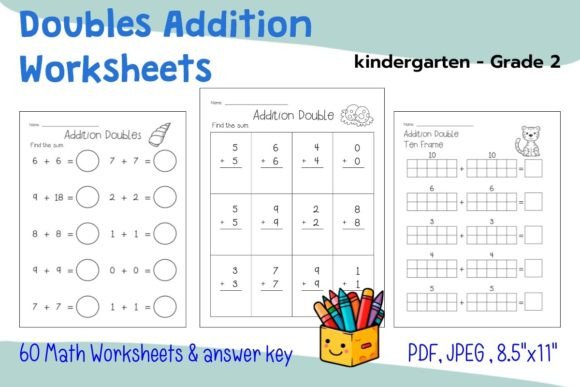
Mastering Early Math with the Math Workbook Addition Double Practice
For kindergarten and early elementary educators, as well as homeschooling parents, finding resources that bridge the gap between abstract numbers and concrete understanding is often the most challenging part of teaching mathematics. The Math Workbook Addition Double Practice addresses this specific need by offering a structured yet engaging approach to one of the foundational pillars of arithmetic: addition doubles. By focusing on visual aids like ten frames and hands-on activities, this resource transforms a potentially dry subject into an interactive learning experience suitable for students from Grade Kindergarten through Grade 2.
The Power of Visual Learning in Early Arithmetic
Young learners do not always grasp the concept of "adding" simply by looking at symbols on a page. They need to see the quantity. This is where the Math Workbook Addition Double Practice shines. The worksheets are specifically designed around the concept of ten frames, a visual tool that helps children visualize numbers up to ten. When a student sees two groups of five dots or circles, they can physically count them, but more importantly, they begin to recognize patterns.
Understanding doubles—such as 3 + 3 or 6 + 6—is crucial because it serves as a mental shortcut for more complex addition later on. If a child knows that 5 + 5 equals 10, solving 5 + 6 becomes much easier; they just need to add one more. The workbook leverages this cognitive strategy by providing repeated exposure to these patterns in a format that feels less like a test and more like a game.
From Abstract to Concrete: The Hands-On Approach
One of the standout features of this collection is its encouragement of tactile interaction. The activities are crafted to enhance understanding by having students visualize the process through drawing circles or using Q-tips and paint. This multi-sensory approach is vital for kinesthetic learners who struggle with purely auditory or visual instruction.
Imagine a classroom scenario where a teacher hands out a worksheet featuring empty ten frames. Instead of just writing the number "4" twice, the child uses a Q-tip dipped in blue paint to dot four spots on the left frame and four on the right. As they create the physical marks, they are reinforcing the muscle memory associated with counting and grouping. This method makes the concept of addition more concrete and engaging for young learners, turning a math lesson into an art project that yields numerical results.
A Comprehensive Toolkit for Educators and Parents
When selecting educational materials, the scope and variety of content are paramount. The Math Workbook Addition Double Practice offers a robust library of exercises totaling 127 pages. This extensive collection ensures that teachers and parents never run out of fresh material, allowing for consistent practice over weeks or even months without repetition fatigue.
The workbook is divided into several distinct categories to cater to different stages of mastery:
- Addition Doubles: Standard horizontal equations that introduce the core concept.
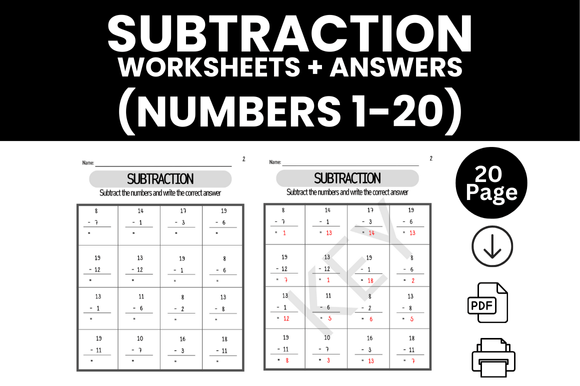
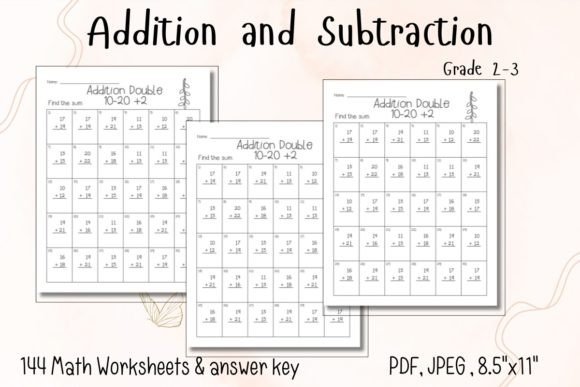
- Vertical Addition Doubles: Exercises formatted vertically to prepare students for column addition methods used in higher grades.
- Addition Doubles with Ten Frames: The visual component where students connect the equation to the graphic representation.
Furthermore, the inclusion of a comprehensive Answer Key saves valuable time for instructors. Whether you are grading a stack of papers after a busy school day or checking your child's work during a homeschool session, having immediate access to correct answers streamlines the feedback loop. This efficiency allows adults to focus more on explaining concepts rather than verifying calculations.
Practicality and Ease of Use in Modern Workflows
In today's fast-paced educational environment, convenience is just as important as content quality. The Math Workbook Addition Double Practice is designed with modern workflows in mind. It comes as a ready-to-print PDF file, ensuring high-quality reproduction on standard home or office printers. The dimensions are set to the universal 8.5″ x 11″ Inch size, meaning no awkward cropping or resizing is required. You can print directly onto cardstock for durability or regular paper for quick drills.
Additionally, the package includes JPG 300 files ready to print. These high-resolution images are perfect for those who prefer to project worksheets onto a smartboard for whole-class instruction or for creating digital assignments on platforms like Google Classroom or Seesaw. The versatility of the file formats means the resource fits seamlessly into both traditional brick-and-mortar classrooms and remote learning environments.
Integrating into Daily Routines
How does this fit into a typical day? For a kindergarten teacher, these worksheets can serve as morning work to get students thinking about math before the main lesson begins. A teacher might project one vertical addition problem and have the class solve it together using whiteboards, then hand out the corresponding ten-frame sheet for independent practice.
For homeschooling parents, the Math Workbook Addition Double Practice can be part of a "math center" rotation. One child might be working on the painting activity while another tackles the vertical addition sheets. The educational clip art graphics included in the design make the pages visually appealing, reducing resistance to "work" time. The colorful, friendly aesthetic keeps the mood light, which is essential for maintaining a positive attitude toward learning math.
Why Focus on Doubles?
It is worth exploring why so much emphasis is placed on doubles in the early grades. In the progression of mathematical fluency, doubles are often considered the first major milestone. Once a student masters doubles (1+1, 2+2, ..., 10+10), they unlock a powerful heuristic for solving near-doubles problems. For example, if a student needs to solve 7 + 8, they can think of it as 7 + 7 plus one more. This mental agility is the foundation of algebraic thinking and rapid calculation.
The Math Workbook Addition Double Practice recognizes this hierarchy of skills. By dedicating 60 specific worksheets to this topic, it ensures that students achieve true fluency rather than just familiarity. Repetition, when done correctly with varied visual contexts, leads to automaticity. When addition becomes automatic, the brain is free to tackle word problems and logical reasoning tasks without getting bogged down by basic computation.
Choosing the Right Resource for Your Needs
When browsing for math materials, there are many factors to consider. Price is often a factor, but value lies in longevity and adaptability. With 127 pages of content, the Math Workbook Addition Double Practice offers significant value per page. Unlike single-use worksheets found in generic packs, these are designed with pedagogical intent. The progression from visual ten frames to abstract vertical numbers mirrors the developmental stages of a child's cognitive growth.
Another consideration is the alignment with curriculum standards. While specific standards vary by region, the focus on place value, addition within 20, and the use of visual models aligns perfectly with Common Core State Standards and similar international frameworks for Grades K-2. Teachers can confidently use these materials knowing they are addressing key learning objectives.
Finally, the aesthetic quality matters. Children are more likely to engage with materials that look inviting. The educational clip art graphics included in this workbook are not merely decorative; they provide context and reduce anxiety. A page filled with mushrooms or stars (as hinted by the 🍄 theme) feels like an adventure, whereas a blank grid feels like a chore. This psychological aspect of design cannot be overstated in early education.
Final Thoughts on Implementation
Implementing the Math Workbook Addition Double Practice into your teaching or parenting routine requires very little setup. Simply download, print, and distribute. However, the impact goes far beyond the printed page. It fosters a deeper understanding of number relationships, encourages fine motor skills through painting and drawing, and builds confidence in young mathematicians.
Whether you are looking to supplement a current curriculum, find extra practice for a struggling student, or simply want high-quality materials for a fun math station, this workbook provides a reliable solution. By combining the rigor of structured practice with the joy of hands-on creativity, it stands out as an essential tool for anyone dedicated to building a strong mathematical foundation for the next generation.